
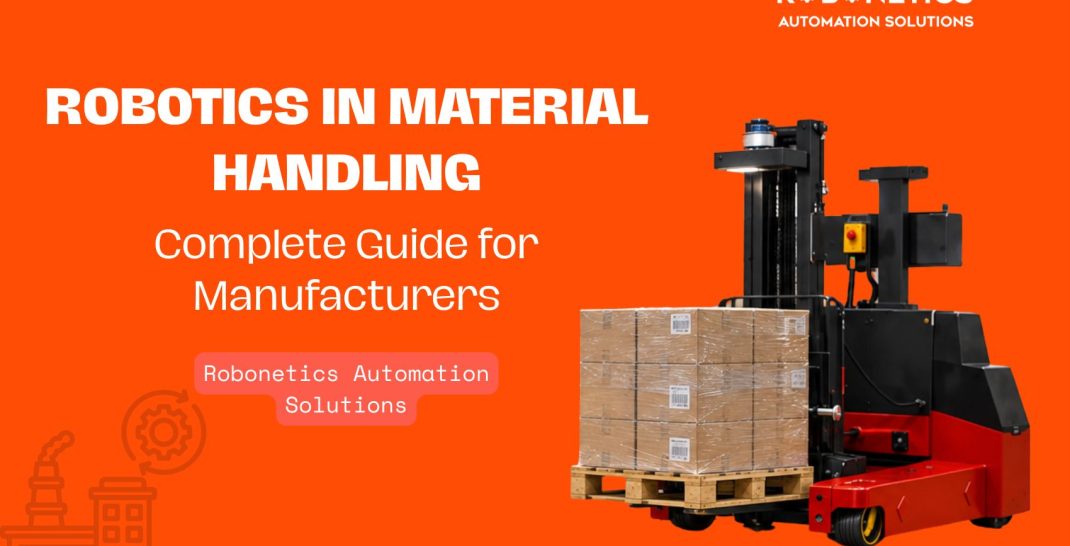
Material handling robots are transforming how manufacturers move, store, sort, and deliver materials across modern facilities.
What Are Material Handling Robots?
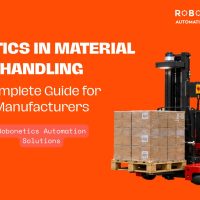
Material handling robots are automated systems designed to transport materials, components, pallets, cartons, and finished products with minimal manual intervention. They can operate across warehouses, production floors, distribution centres, and assembly lines.
Modern robotic systems can perform repetitive transportation tasks while improving consistency, workplace safety, and operational visibility.
Key applications include:
- Moving raw materials between storage and production areas
- Transporting finished goods to dispatch zones
- Delivering components to assembly stations
- Moving pallets and heavy loads
- Supporting picking, sorting, and replenishment
- Automating repetitive internal transportation
How Material Handling Robots Improve Manufacturing
Manufacturers increasingly use material handling robots to address labour shortages, improve throughput, and reduce unnecessary movement inside facilities.
The major benefits include:
- Higher productivity: Robots can operate continuously across multiple shifts.
- Improved safety: Automated transportation reduces exposure to heavy lifting and vehicle-related risks.
- Better accuracy: Automated navigation and predefined workflows minimise transportation errors.
- Lower operating costs: Automation can reduce repetitive manual handling requirements.
- Scalability: Robotic fleets can be expanded as production requirements increase.
- Real-time visibility: Software can provide information about robot activity, task status, and utilisation.
💡 TIP & TRICK: Before selecting a robot, map the complete material flow. Identify where materials wait, where operators walk unnecessarily, and where transportation creates production bottlenecks.
AMR and AGV Solutions for Material Movement
An AMR/AGV Manufacturer can provide different automation approaches depending on facility requirements. AGVs generally follow predefined routes, while AMRs can use sensors, maps, software, and intelligent navigation to adapt to changing environments.
AMRs are particularly useful in dynamic manufacturing environments where people, equipment, and materials frequently change positions.
Typical use cases include:
- Line-side material delivery
- Pallet transportation
- Warehouse replenishment
- Finished goods movement
- Kitting operations
- Inter-floor transportation
- Dock-to-storage movement
An experienced AMR/AGV Manufacturer can evaluate payload, travel distance, floor conditions, traffic patterns, safety requirements, and integration requirements before recommending a suitable system.
Industries Automation Robots Are Supporting
The adoption of Industries Automation Robots is expanding across several manufacturing sectors. Robotics is no longer limited to highly automated automotive facilities.
Common applications include:
- Automotive and auto components
- Electronics manufacturing
- Pharmaceuticals
- Food and beverage
- FMCG
- Warehousing and logistics
- Engineering and heavy manufacturing
- E-commerce fulfilment
These systems can support both small-scale operations and large facilities with thousands of daily material movements.
Material Movement Robots and Intelligent WMS
Material movement robots become significantly more effective when connected with an intelligent Warehouse Management System (WMS).
An intelligent WMS can manage inventory locations, orders, replenishment requirements, and task priorities. The robotic system can then receive transportation instructions based on real-time warehouse requirements.
This creates a connected workflow:
Order → Intelligent WMS → Task Allocation → Robot Dispatch → Material Movement → Task Completion
The combination helps manufacturers coordinate inventory and transportation instead of operating robots as isolated machines.
An AMR/AGV Manufacturer with strong software integration capabilities can connect robotic fleets with WMS, ERP, MES, and other factory systems.
💡 TIP & TRICK: Do not evaluate WMS and robotics separately. Check whether your WMS can communicate with the robot fleet through APIs, middleware, or standard integration protocols.
Fleet Management Software for Robotic Operations
When multiple robots operate simultaneously, fleet management software becomes essential. It acts as the coordination layer for the robotic fleet.
Important capabilities include:
- Robot assignment and task allocation
- Traffic management
- Battery monitoring
- Charging management
- Priority-based task scheduling
- Robot utilisation tracking
- Error and alert monitoring
- Performance reporting
For example, if five robots are transporting materials and one robot requires charging, fleet management software can redistribute tasks among available robots. This helps maintain workflow continuity.
Material movement robots can therefore operate as a coordinated fleet rather than independent transportation units.
How to Select the Right Robotic System
Manufacturers should consider operational requirements before investing in automation.
Evaluate:
- Payload capacity – Determine the maximum weight each robot must carry.
- Travel distance – Calculate average and peak transportation distances.
- Navigation requirements – Assess whether fixed routes or dynamic navigation are more suitable.
- Floor conditions – Check flooring, ramps, thresholds, and environmental conditions.
- Traffic density – Analyse interaction between robots, workers, forklifts, and machinery.
- Integration – Verify compatibility with WMS, ERP, MES, and production systems.
- Safety – Ensure appropriate obstacle detection, emergency controls, and safety protocols.
- Future scalability – Select a solution that can support additional robots when demand increases.
Implementation Challenges Manufacturers Should Consider
Robotic automation can deliver substantial benefits, but implementation requires proper planning.
Potential challenges include:
- Inconsistent warehouse layouts
- Poorly defined material-flow processes
- Inadequate network infrastructure
- Lack of system integration
- Employee training requirements
- Battery and charging management
- Insufficient floor markings or operational zones
- Incorrect task prioritisation
A detailed site assessment can identify these issues before deployment.
💡 TIP & TRICK: Start with a high-volume, repetitive transportation route instead of automating every process at once. Measure results, optimise the workflow, and then expand the fleet.
Future of Robotics in Material Handling
The next generation of material handling robots will increasingly combine artificial intelligence, computer vision, advanced sensors, analytics, and cloud-based software.
Manufacturers can expect greater emphasis on:
- AI-based task optimisation
- Smarter traffic management
- Predictive maintenance
- Autonomous charging
- Vision-based navigation
- Real-time operational analytics
- Multi-robot coordination
- Integration with smart factories
As manufacturing moves toward Industry 4.0, Industries Automation Robots will increasingly operate as part of connected production ecosystems rather than standalone machines.
Final Thoughts
Robotic material transportation can help manufacturers create safer, more productive, and data-driven operations. The right combination of robotics, intelligent WMS, and fleet management software can connect material flow from storage through production and dispatch.
Choosing the right technology partner is equally important. Manufacturers should assess payload, navigation, integration, safety, scalability, and total operating requirements before deployment.
With a structured automation strategy, material movement robots can become a practical foundation for modern manufacturing and warehouse operations.