
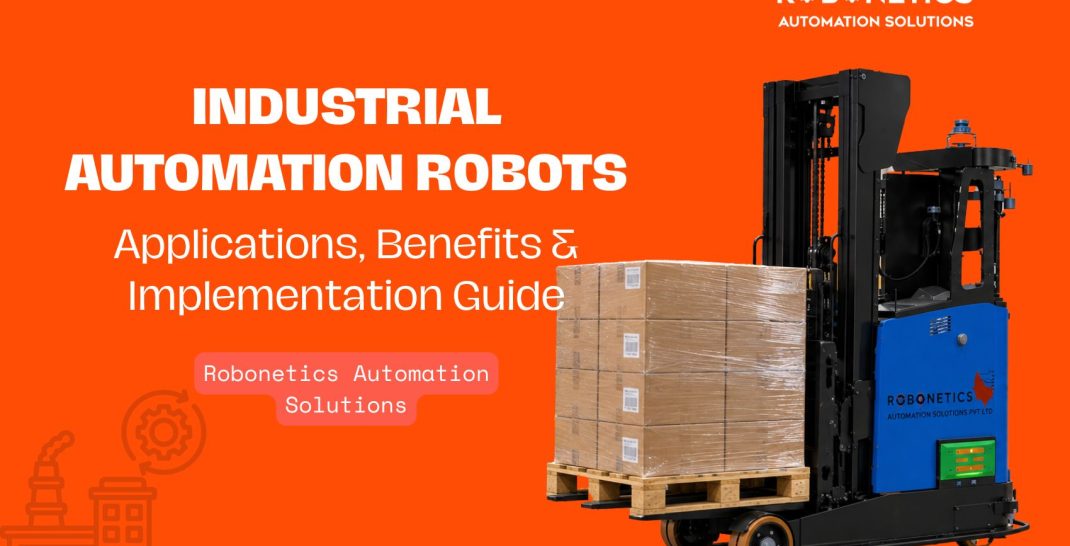
Industrial Automation Robots are transforming manufacturing through faster, safer, and more consistent operations.
What Are Industrial Automation Robots?
Industrial Automation Robots are programmable machines designed to perform repetitive, precise, and physically demanding tasks with minimal human intervention. They are increasingly used in manufacturing plants, warehouses, assembly facilities, and logistics operations.
Depending on the application, robotic systems can perform:
- Material transportation
- Assembly and component handling
- Machine tending
- Palletising and depalletising
- Welding and fabrication
- Picking and sorting
- Packaging
- Inspection and quality control
Unlike traditional automation systems that may require fixed infrastructure, modern robotic solutions can offer greater flexibility and scalability.
Applications of Industrial Automation Robots
The use of Industrial Automation Robots has expanded beyond traditional automotive production. Modern factories use robotics across multiple stages of their operations.
1. Material Handling
Robots can transport raw materials, components, work-in-progress products, and finished goods between different production areas.
Common applications include:
- Line-side delivery
- Pallet transportation
- Warehouse replenishment
- Component movement
- Finished-goods transportation
Material Movement robots can reduce unnecessary walking and manual transportation while maintaining a predictable material flow.
2. Assembly Operations
Robotic systems can perform repetitive assembly activities with consistent accuracy. They can position components, fasten parts, and transfer products between workstations.
This is particularly useful where high production volumes require consistent cycle times.
3. Machine Tending
Robots can load and unload CNC machines, presses, injection moulding machines, and other equipment.
Benefits include:
- Consistent machine loading
- Reduced operator exposure to hazardous areas
- Improved machine utilisation
- Continuous operation across shifts
4. Palletising and Depalletising
Robots can automatically stack products onto pallets or remove products from incoming pallets. This reduces repetitive lifting and helps standardise warehouse operations.
5. Inspection and Quality Control
Robotic systems integrated with cameras and sensors can support automated inspection. They can identify defects, verify dimensions, and check product positioning.
💡 TIP & TRICK: Identify processes with high repetition, predictable workflows, and measurable cycle times first. These usually provide the clearest starting point for robotic automation.
Role of an AMR Manufacturer in India
An AMR Manufacturer in India can help businesses automate internal transportation using Autonomous Mobile Robots. AMRs use sensors, navigation technologies, software, and maps to move through changing industrial environments.
Unlike fixed-route transportation systems, AMRs can dynamically navigate around people and obstacles.
Typical AMR applications include:
- Raw-material transportation
- Warehouse-to-production movement
- Kitting
- Order fulfilment
- Line-side delivery
- Finished-product movement
When evaluating an AMR Manufacturer in India, manufacturers should assess payload capacity, navigation technology, fleet software, safety systems, charging requirements, and integration capabilities.
Benefits of Industrial Robotics
The adoption of Industrial Automation Robots can provide operational and financial advantages when implemented correctly.
Increased Productivity
Robots can perform repetitive tasks consistently and support multi-shift operations.
Improved Workplace Safety
Automating heavy lifting and repetitive transportation can reduce employees’ exposure to physically demanding activities.
Better Accuracy
Robotic systems can execute predefined tasks with consistent positioning and repeatability.
Reduced Operational Bottlenecks
Automation can improve the movement of materials between workstations and reduce waiting time.
Scalability
Businesses can expand robotic capacity as production requirements increase.
💡 TIP & TRICK: Don’t calculate ROI only from labour savings. Include productivity gains, reduced downtime, safety improvements, quality benefits, and additional production capacity.
Industries Using Automation Robots
Industries Automation Robots are increasingly being deployed across diverse sectors.
Major applications include:
- Automotive and auto components
- Electronics
- Pharmaceuticals
- Food and beverage
- FMCG
- E-commerce
- Warehousing and logistics
- Engineering
- Heavy manufacturing
For example, an automotive facility may use robots for assembly and welding while AMRs transport components between storage and production areas.
How to Implement Industrial Robotics
Successful implementation requires more than purchasing robotic equipment. Manufacturers should begin with a detailed analysis of their existing workflows.
Step 1: Identify the Process
Select repetitive, high-volume, or physically demanding operations.
Step 2: Analyse Material Flow
Document movement distances, payloads, frequency, traffic, and current bottlenecks.
Step 3: Select the Technology
Determine whether robotic arms, AMRs, AGVs, or another robotic platform is appropriate.
Step 4: Plan System Integration
Consider integration with:
- ERP systems
- MES platforms
- Warehouse Management Systems
- Fleet management software
- Production equipment
Step 5: Conduct a Pilot
Begin with one process or operational zone and measure performance before scaling.
Step 6: Expand the Solution
Use pilot results to improve workflows and gradually deploy robotics across additional areas.
For companies looking for industrial automation robots for manufacturing, evaluating the complete workflow rather than an individual robot can lead to better long-term results.
Challenges to Consider
Robotic implementation can involve several challenges.
- Initial investment requirements
- Facility layout limitations
- Integration complexity
- Employee training
- Network infrastructure
- Safety compliance
- Maintenance planning
- Battery and charging management
Working with an experienced AMR Manufacturer in India can help businesses address these requirements during planning and deployment.
Future of Industrial Robotics
The future of Industrial Automation Robots is closely connected with artificial intelligence, computer vision, advanced sensors, cloud platforms, and real-time analytics.
Emerging capabilities include:
- AI-based task optimisation
- Predictive maintenance
- Autonomous charging
- Intelligent traffic management
- Vision-based navigation
- Real-time performance monitoring
- Multi-robot coordination
Industries Automation Robots will increasingly operate as connected components of smart factories rather than isolated machines.
💡 TIP & TRICK: Plan for future integration before deployment. Choose robotic platforms that can communicate with your existing and planned factory software.
Conclusion
Industrial robotics is becoming an important part of modern manufacturing, helping businesses improve productivity, safety, consistency, and material flow.
From machine tending and assembly to Material Movement robots, manufacturers can select technologies based on their specific operational requirements.
Businesses evaluating industrial automation robots for material handling should consider the complete automation ecosystem, including robotics, software, safety, integration, and scalability.
With careful planning and the right technology partner, robotics can become a scalable foundation for efficient and connected manufacturing operations.